Kagoshima, Japan: Volcano Views, Samurai History and Southern Kyushu
Kagoshima is one of the most distinctive places to visit in southern Japan, with Sakurajima rising across the bay and a history shaped by samurai rule, trade and early industry. Whether you arrive by ship or as part of a wider Kyushu trip, it offers a striking mix of scenery and heritage.
Where is Kagoshima?
Kagoshima is in Kyushu, the southernmost of Japan’s four main islands. If you picture Japan stretching from north to south, Kagoshima sits a long way below Tokyo, on the southern side of the country, facing Kagoshima Bay.
Map showing the location of Kagoshima in southern Japan.
That southern setting gives it a different feel from the places many first-time visitors know best. Tokyo is around 600 miles to the north east, while Kagoshima feels closer to the edge of Japan, both geographically and in atmosphere. The bay is broad, the light can feel softer, and the great presence in the landscape is Sakurajima, the active volcano that rises just across the water.
For many travellers, Kagoshima is a first glimpse of southern Japan, and it makes a strong impression.
What is Kagoshima known for?
Kagoshima is best known for three things: Sakurajima, the Shimazu clan, and its role in Japan’s early industrial development.
Sakurajima is the city’s defining landmark. The volcano dominates the skyline across the bay and gives Kagoshima a sense of drama that is quite unlike other Japanese cities.
Kagoshima was also the centre of the old Satsuma domain, ruled by the powerful Shimazu clan for centuries. Their former estate at Sengan-en remains one of the city’s most important visitor sites and is the best place to begin understanding Kagoshima’s past.
Less obviously, Kagoshima also played a part in Japan’s shift from a feudal society to a more modern industrial nation. That story becomes clearer at Sengan-en, because just beside the estate is Shoko Shuseikan, a group of historic industrial buildings linked to the Shimazu family’s early experiments in manufacturing and engineering. In other words, one visit can show you both the world of the samurai rulers and the beginnings of modern industry.
Why visit Kagoshima?
Kagoshima stands out because it brings together dramatic scenery and strong historical identity in one compact area. Even on a short visit, it gives you a clear sense of place.
This is not somewhere you visit only for a city centre stroll. The appeal lies in the wider setting: a historic estate looking across to an active volcano, a short crossing by ferry, and a landscape that feels shaped by fire, ash and sea. For visitors interested in places where history and geography are closely connected, Kagoshima has real character.
When we visited, the weather was overcast, which softened some of the colours in the gardens, but it suited the city in another way. Sakurajima felt even more imposing under a grey sky.
Best things to do in Kagoshima
Visit Sengan-en
Sengan-en is one of the key places to visit in Kagoshima and the best starting point for understanding the city’s history.Built in 1658 by Mitsuhisa Shimazu, it was created as a residence for the Shimazu clan, who ruled this part of Japan for centuries. Like Dejima in Nagasaki, it belongs to the long Tokugawa period, though here the story is one of clan power rather than foreign trade.
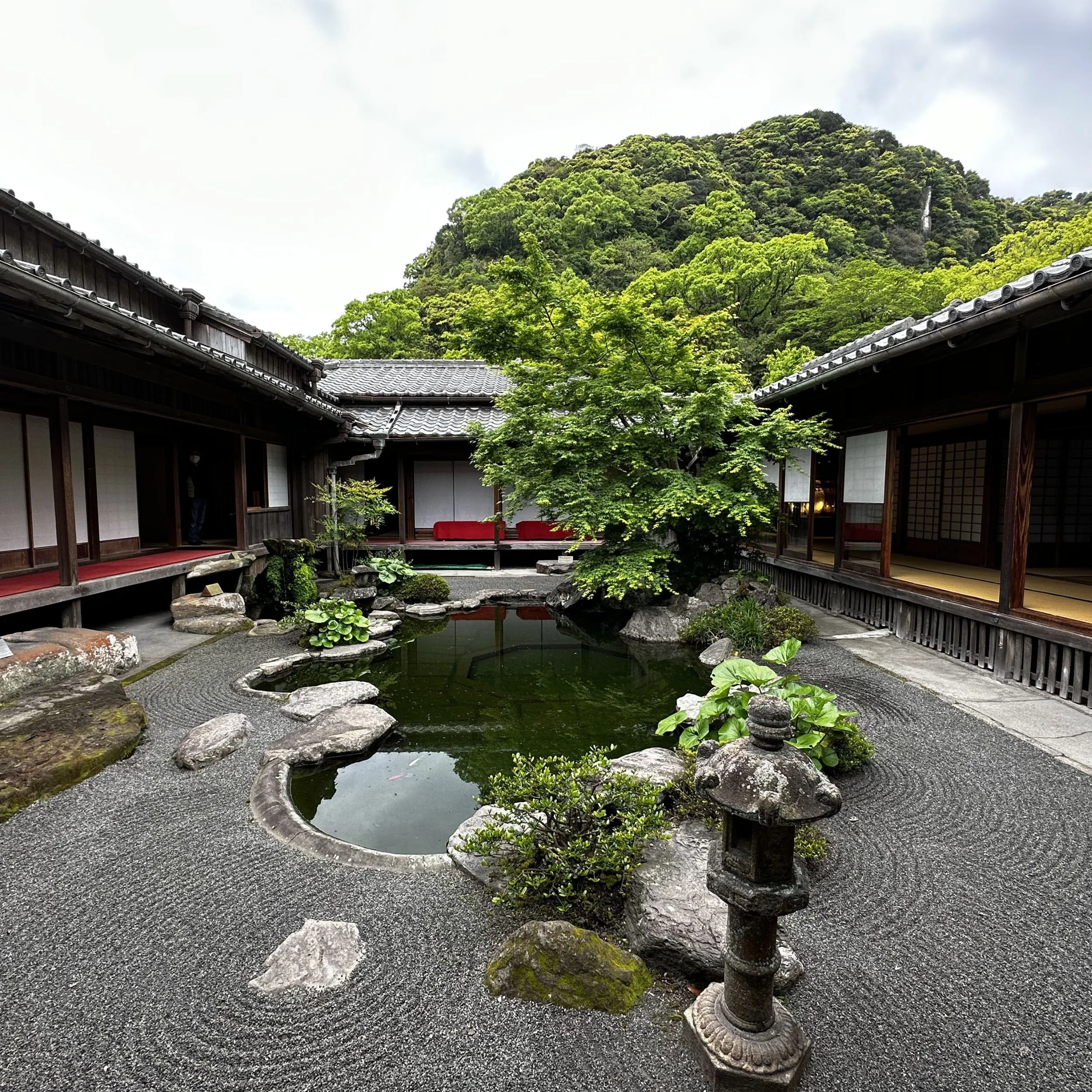
A quiet courtyard inside the Sengan-en house, where raked gravel, water and timber architecture bring a more intimate side of the estate into view.
The site combines house, gardens and bay views in a way that immediately explains its importance. From the grounds, you look out over the water towards Sakurajima, with the volcano forming part of the overall scene rather than sitting beyond it.
Borrowed scenery, or shakkei, is a Japanese garden design idea in which the landscape beyond the garden is treated as part of the composition.
At Sengan-en, Sakurajima and Kagoshima Bay are not just the backdrop. They are part of the design itself.
Inside the house, one detail that stood out was the low ceiling height. It offers a sharp contrast with the lofty rooms of grand houses in Europe from around the same period. After a few bumps on the head during our visit, it was not just a historical observation.
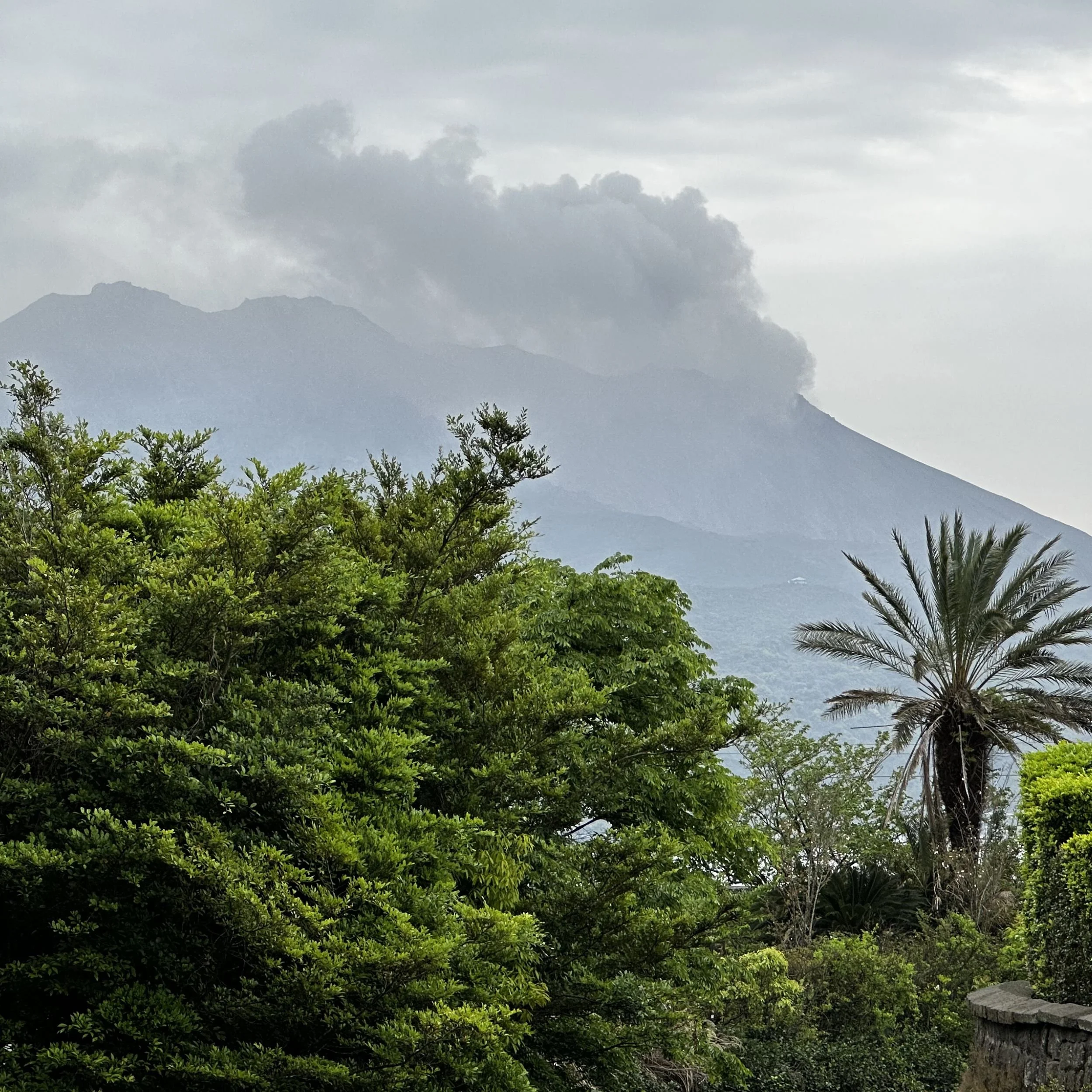
The view from Sengan-en towards Sakurajima, with the smoking volcano forming part of the garden’s borrowed scenery.
Sengan-en also leads directly into Kagoshima’s industrial story. Just beside the estate is Shoko Shuseikan, where surviving factory buildings and displays help explain how the Shimazu family were involved in some of Japan’s earliest industrial development. That close physical link makes the story much easier to grasp than if the two sites were separated.
See Sakurajima up close
Sakurajima is the natural symbol of Kagoshima and a major reason many people want to visit. Seeing it across the bay is one thing. Going over to it is another.
Reached by ferry from Kagoshima, Sakurajima offers a more rugged and immediate experience than the city itself. The terrain is darker, the air can carry a noticeable sulphur smell, and the landscape feels shaped by repeated eruptions.
Whilst there is not lava spewing out of the mountain, it was still quite an experience to walk around this almost lunar landscape with the smoking volcano just metres away. That closeness is what makes the visit memorable. It does not feel theatrical or overdone. It simply feels real.
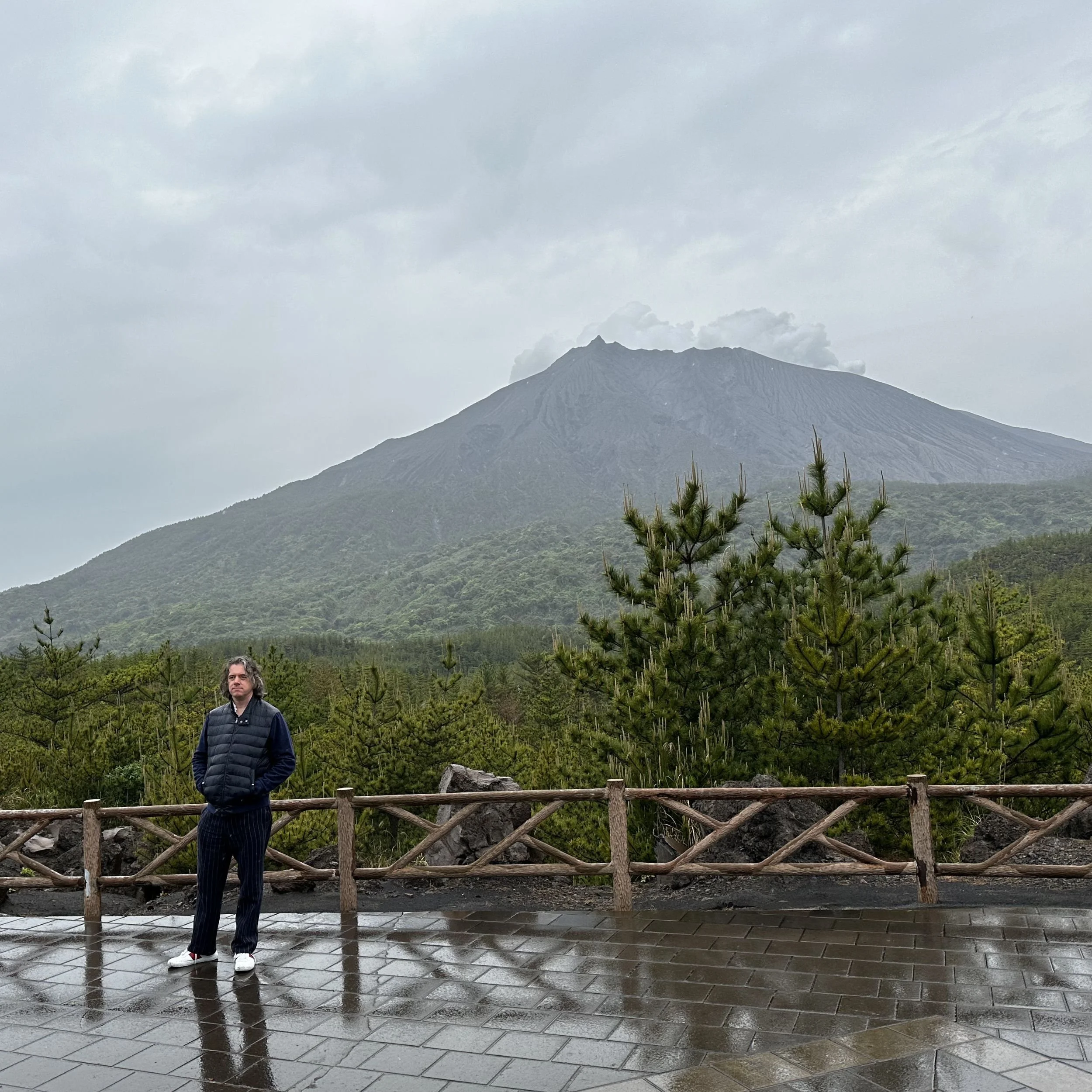
Up close to Sakurajima in wet weather, with the smoking volcano rising above the dark volcanic landscape.
If Sengan-en helps explain Kagoshima’s history, Sakurajima helps explain its atmosphere.
Kagoshima on a Japan cruise
Kagoshima works well as a stop on a Japan cruise because its main sights are strong, distinctive and relatively easy to understand in a limited amount of time. Even within a day, visitors can come away with a clear sense of what makes the city special.
Sengan-en and Sakurajima make a particularly good pairing. One gives you the historical and cultural background, the other gives you the physical force that defines the place. Together they offer a rounded introduction to Kagoshima.
At the same time, Kagoshima does not feel like a place that has been reduced to a single excursion. It has enough character to suggest there is more to it than you can cover in a few hours.
Visiting Kagoshima independently
Kagoshima is not only a port stop. It also works as part of an independent trip through Kyushu. The city is connected to the wider rail network by the Kyushu Shinkansen, which makes it easier to include in a broader southern Japan itinerary.
Kagoshima can easily be combined with other places in Kyushu rather than treated as somewhere separate or difficult to reach. For travellers interested in seeing a different side of Japan beyond the usual first-time route, it makes a strong southern anchor.
How much time do you need in Kagoshima?
A day is enough to get a strong first impression of Kagoshima, especially if you focus on Sengan-en and Sakurajima. Those two sites capture the city’s main themes: historic power, industrial change and volcanic landscape.
With more time, Kagoshima would likely reward a slower visit. Its setting is one of its strengths, and this is the kind of place that benefits from a little room to look around rather than rushing from stop to stop.
Is Kagoshima worth visiting?
Yes, particularly for travellers interested in places where landscape and history are tightly bound together. Kagoshima offers one of the strongest senses of place on a Japan itinerary, thanks to the constant presence of Sakurajima and the city’s ties to the Shimazu clan and early industrial change.
For us, it offered a clear introduction to a different side of Japan, one shaped as much by volcanic force and southern geography as by the formal images many visitors know already.