Taking the Train Around France: A Better Way to Travel
Choosing trains over planes opens up a new way to experience France. European rail travel is nothing new, but in recent years it has felt more appealing as cheap flights have become less predictable. Airline strikes, baggage chaos and the general friction of short-haul flying have made the train look increasingly attractive, particularly for travellers who value comfort and convenience.
For a summer holiday in the South of France, travelling by train can feel like part of the trip in the best sense. You can, if you want to, get from London to Nice in a single day. Break the journey, though, and the route opens up: Paris, Lille, Avignon, Aix-en-Provence, Marseille, Cannes. It becomes not just a way of reaching the south, but a way of seeing more of France on the way there.
Why travel around France by train?
On the surface, train travel can feel slower than flying. Yet once you factor in airport transfers, early check-in, security queues and the dead time built into most short-haul flights, the comparison changes. A flight from London to Nice might be only a couple of hours in the air, but it is rarely a short day door to door.
Driving brings a different set of compromises. It offers freedom, but also tolls, traffic, parking and the fatigue of a long day on the road. For an upmarket traveller looking to combine several destinations in one holiday, high-speed rail often sits in a more comfortable middle ground.
Most rail stations are central, even if some TGV Grand Ligne stations sit a little further from the heart of a city. Boarding is simpler, luggage rules are more forgiving, and the overall experience is far less draining than a short-haul flight. Price can be part of the appeal too. This summer, a direct first-class train from Paris to Nice can cost as little as £59. You could have an early lunch at Le Train Bleu in Gare de Lyon, board the train, and still arrive in Nice in time for dinner.
There is also the question of what the journey gives back. There is room to read, work, have lunch or simply watch the country change outside the window. France suits this style of travel particularly well. Lille works beautifully from London. Paris remains the natural hub. Avignon and Aix-en-Provence open up Provence. Marseille offers a more layered Mediterranean city, while Cannes and Nice bring the coast within reach without the immediate need to pick up a hire car.
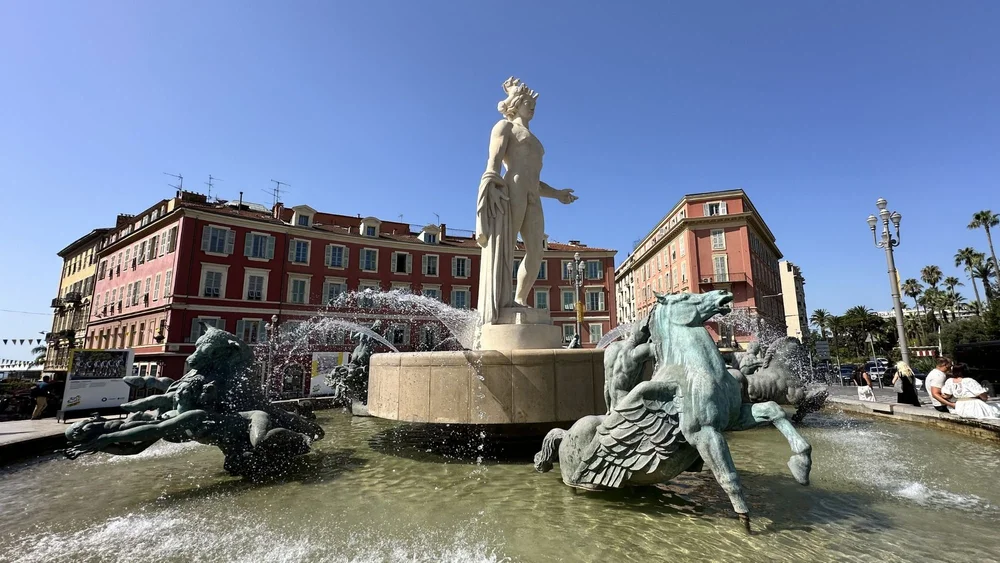
How France’s high-speed rail network works
The TGV, or Train à Grande Vitesse, is France’s high-speed train service, running at up to 320 km/h on dedicated high-speed tracks known as the LGV, or Lignes à Grande Vitesse. Since 1981, these lines have connected Paris with much of the country and created one of the fastest and most efficient rail networks in Europe, drawing comparison with the famous Shinkansen Bullet Trains of Japan.
The basic geography is easy enough to understand. The fastest sections of a journey take place on the dedicated high-speed lines. Once the train leaves them and joins conventional track, the pace drops. Some routes remain fast for almost the entire trip. Others slow as they approach the coast or move beyond the main corridors.
The route south from Paris is a good example. Paris to Marseille is high-speed for much of the journey. Beyond Marseille, as the train continues towards Cannes and Nice, it slows along the coast. That does not diminish the route. It simply changes the pace a little. The final stretch is less about speed and more about the pleasure of arriving gradually, with sea views and shifting Mediterranean light outside the window.
For travellers, that is useful to know not as rail theory, but as a planning tool. France works well for rail holidays because the longer jumps between regions are fast enough to be practical, while the slower stretches often bring the best scenery.
The main train brands to know

Two TGV trains with different brands
High-speed rail in France is no longer the sole preserve of SNCF. On some routes, you now have a choice of operator, which gives travellers more flexibility on style, price and onboard experience. Whilst they will all run the TGV trains, the interior set up, and exterior branding will be different.
TGV INOUI
TGV INOUI remains the flagship French service. Sleek, modern and frequent, it is still the default choice on many of the country’s major routes. On journeys such as Paris to Aix-en-Provence or Paris to Marseille, it is usually the most obvious option.
In first class, it offers the level of comfort most travellers want for a longer journey: decent seating, power at your seat and enough space to settle in properly. It feels calm and well judged rather than showy.
OUIGO
OUIGO is SNCF’s lower-cost brand. Where it runs, it can be useful for cheaper fares, though the experience sits closer to budget aviation, with fewer frills and less flexibility. For some travellers that will be perfectly acceptable. For others, especially those carrying more luggage or looking for a smoother experience, it will feel less appealing.
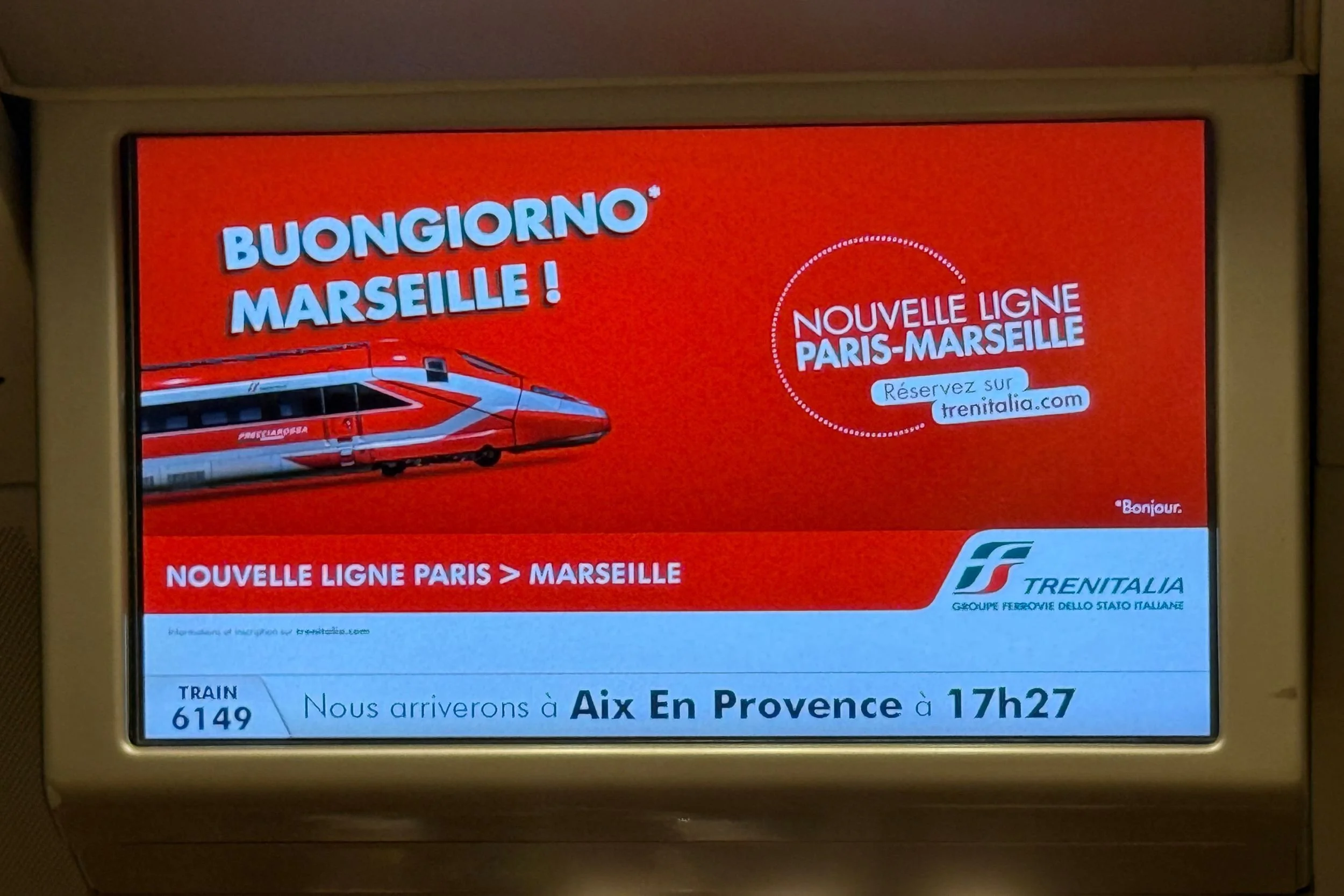
On board with Trenitalia’s Frecciarossa
Frecciarossa
On selected routes south from Paris, Trenitalia’s Frecciarossa offers a genuine alternative. These Italian-operated trains share the same broad corridor as TGV services and in some respects feel slightly more polished. We found the interiors smart, the Wi-Fi strong and the service style distinctively Italian.
There are also small touches that stay with you. Complimentary coffee and pastries at your seat do not transform a journey, but they do reinforce the sense that crossing a country by train can still feel orderly and enjoyable. For travellers looking at Paris, Aix-en-Provence or Marseille, Frecciarossa is well worth comparing with INOUI.
The routes that make train travel in France so appealing
The real strength of French rail travel lies not only in the trains themselves, but in the journeys the network makes possible.
Lille
From London, Lille is one of the easiest cities in France to reach by rail and one of the most overlooked. It works well as a short break in its own right, but it also makes a useful first stop on a longer trip. Instead of rushing straight through Paris, you can pause in Lille for a night or two before continuing south.

Lille Opera House at Dusk
There is sometimes a direct Lille to Aix-en-Provence train, which opens up the possibility of crossing France without doubling back through the capital. For travellers planning a France-by-rail itinerary from the UK, Lille is more than convenient. It is strategically useful.
Paris
Paris remains the centre of gravity. Most international rail journeys still converge here, and many of the country’s fastest lines radiate out from the capital. Spend a few nights in Paris, then continue south, west or north by TGV.
It is easy to think of Paris as the end of the journey. By rail, it often makes more sense as the beginning of a wider one. You could take a couple of nights at the Hôtel Madeleine Plaza (a few stops on the Metro) before moving on.
Aix-en-Provence
Aix-en-Provence is one of the strongest arguments for taking the train south. It offers a graceful Provençal contrast to Paris, and arriving by TGV feels far simpler than flying into a regional airport and collecting a car straight away. From Aix, you can stay put, explore Provence or continue onwards.
For travellers who prefer to link cities before heading into more rural parts of the country, Aix makes a strong starting point.
Avignon
Avignon sits naturally within the same rail geography. High-speed connections place it comfortably within reach of Paris, while its position in Provence makes it an appealing cultural stop between the capital and the coast. For travellers shaping a wider southern itinerary, it is an easy city to fold in.
Marseille
Marseille works well by train because you arrive in the middle of the city without the friction of a road approach. Instead of traffic, tolls and navigation, you step off and begin from there.
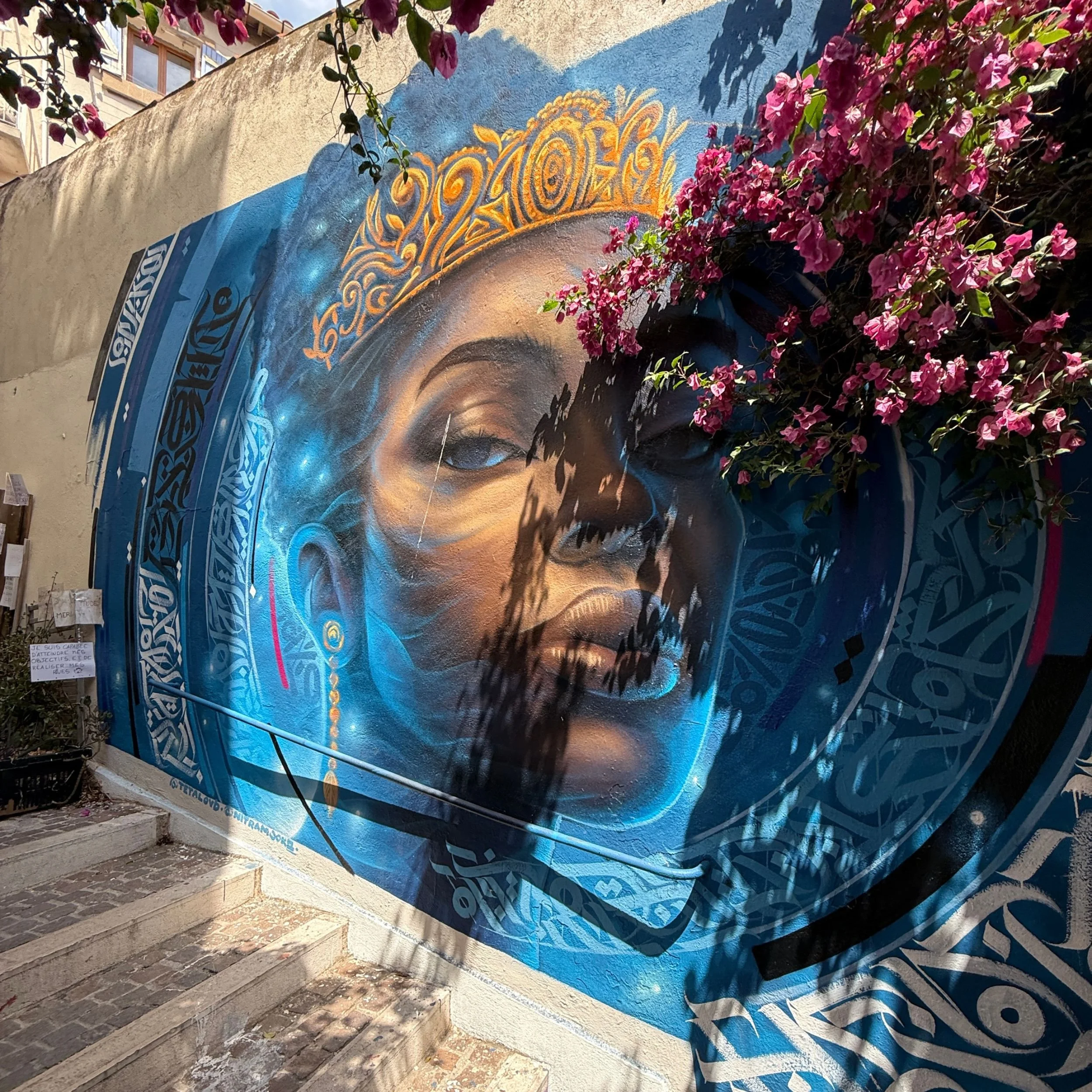
Street Art in Marseilles
It can be a destination in its own right or a natural hinge point between inland Provence and the Mediterranean coast. As part of a wider trip, rail makes Marseille feel closer and easier to combine with other stops.
Cannes
Cannes is often framed through festival glamour, hotels and Riviera polish, but by rail it becomes part of a connected southern route. It can sit neatly between Marseille and Nice, or form part of a Riviera itinerary that avoids repeated transfers and the effort of self-driving.
Nice
Nice is one of the best examples of why long-distance rail works so well in France. On paper, flying may seem quicker. In reality, the train from Paris can feel more coherent once you factor in the full day. You avoid the airport routine, keep your luggage with you, and spend the journey in a proper seat with space, power and a changing view.

Inside the Iconic Negresco Hotel, Nice.
The approach along the coast only adds to the appeal. From Marseille onwards the pace slows, but the trade-off is the scenery: coastal towns, flashes of sea, Cannes along the way, then the distinctive buildings that announce your arrival in Nice at the end of the TGV line.
How to build a France trip around the train network
The easiest way to understand the value of French rail travel is to think in itineraries rather than single journeys.
One version is London, Lille and Paris, with the option to continue south. It keeps the opening leg of the trip simple and gives shape to the holiday before Provence or the Riviera even begins.
Another is Paris, Aix-en-Provence, Marseille and Nice. This is one of the clearest expressions of what France does so well by train: you begin in the capital, shift south with ease, then continue along a line of destinations that each offer something different.
A third option is to leave the trip there and pair Paris with just one southern city rather than several. Aix-en-Provence suits travellers who want a poised Provençal base. Marseille works for those looking for a larger, more dynamic Mediterranean city. Nice combines coast, culture and city-break appeal in one place.
Rail will not replace every other form of travel in France. Rural wine regions, villages and more remote countryside often still reward having a car. But the train is ideal for the larger movements of a trip. It reduces friction between regions and leaves the car, when needed, for the right part of the holiday rather than all of it.
What first class is like on French high-speed trains
For British travellers used to the frustrations of domestic rail, first class on French high-speed services can feel refreshingly straightforward. This is not theatrical luxury. It is space, quiet and a far better environment for several hours of travel.
On our summer journey, first class made a real difference. There was room to settle in, store luggage without anxiety and enjoy the trip rather than simply get through it. Power at your seat matters more on a five-hour journey than on a commuter service. So does a carriage designed for people travelling a real distance.
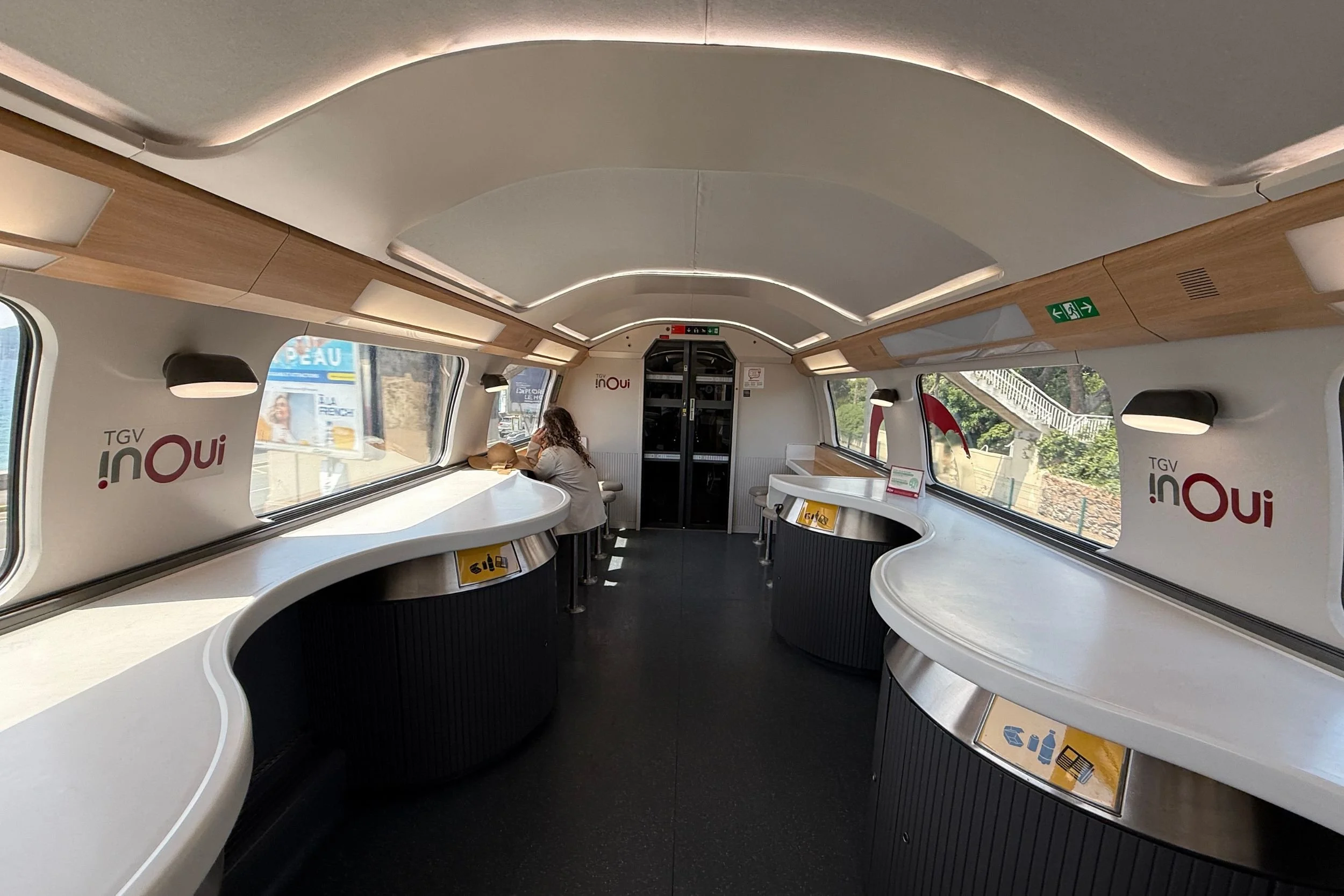
The futuristic cafe bar onboard TGV inOui
The differences between operators are worth noting too. TGV INOUI feels polished and dependable. Frecciarossa has a slightly different character, with comfortable leather seating, strong Wi-Fi and small touches of onboard service that feel warmly continental rather than corporate.
It is less about luxury in the old railway sense and more about comfort, ease and enough calm to make the hours enjoyable.
Train Booking tips worth knowing
Booking early helps, especially on the most desirable routes and the fastest direct services. Not all high-speed trains on the same route take the same amount of time, and the quickest departures can sell out sooner. That is particularly relevant on routes such as Nice to Paris, where some services are much faster than others.
The UK Trainline app now has the option to book and manage SNCF tickets, which is a great help.
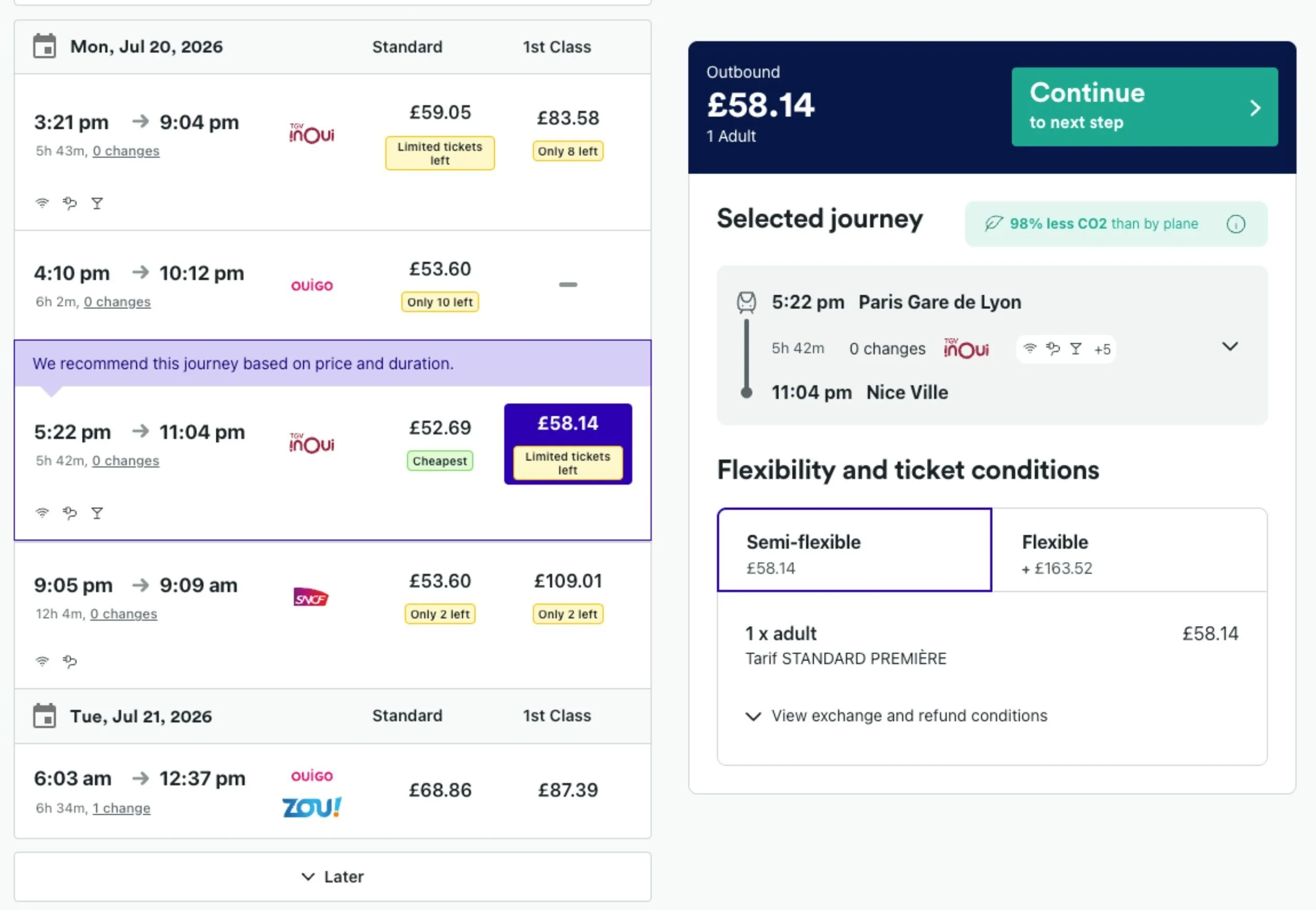
A Trainline screenshot highlighting the times, trains and costs of Paris to Nice.
It is worth creating an SNCF account and linking your bookings where possible. Additional services such as lost luggage will be connected to your SNCF account, so too credits for late trains. The SNCF Gares app is also useful in larger stations, where knowing your platform in good time can remove a surprising amount of stress.
When things go wrong
Trains, like flights, do not always run perfectly. In Summer 2025, our planned five-hour journey from Nice to Paris was disrupted by a lightning storm outside Dijon, forcing the train onto slower lines and turning what should have been an early evening arrival into a late one. The onboard bar ran short on food and drink, and the day stretched far beyond what we had expected.
Even so, it did not alter our broader view of the experience. Delays happen in every form of travel. Flights are cancelled, roads snarl up, connections are missed. We were still comfortable, together and moving steadily towards Paris without the harder edges of airport disruption.
We had a similar experience when we left a bag on a train at Marseille. The lost property service was excellent. The bag was located within hours and ready for collection for a small fee. An inconvenience, yes, but also evidence that the system can work well when you need help.
Why France by train makes sense
Travelling around France by high-speed rail is not simply an alternative to flying or driving. Used well, it becomes one of the best ways to shape a trip. You get speed where speed helps, comfort where comfort counts and a clearer sense of the country between destinations.
For an upmarket UK traveller, that can mean leaving London, pausing in Lille or Paris, then continuing south to Aix-en-Provence, Marseille, Cannes or Nice without the stop-start fatigue that often comes with short-haul flying or long drives. It can also mean treating the journey as part of the holiday rather than an obstacle to be endured.
The TGV and the wider French rail network deserve to be seen as more than transport. They are one of the most useful tools for building a well-paced trip through France, especially for travellers who value convenience without giving up scenery, movement and discovery.
France remains one of Europe’s most rewarding countries to travel through. Its trains are one of the clearest reasons.